
How to Do a Shoulder External Rotation Stretch Without Forcing Layback
How pitchers can perform a gentle stick-assisted external rotation stretch, with setup, form checks, dosage context and clear reasons to stop.
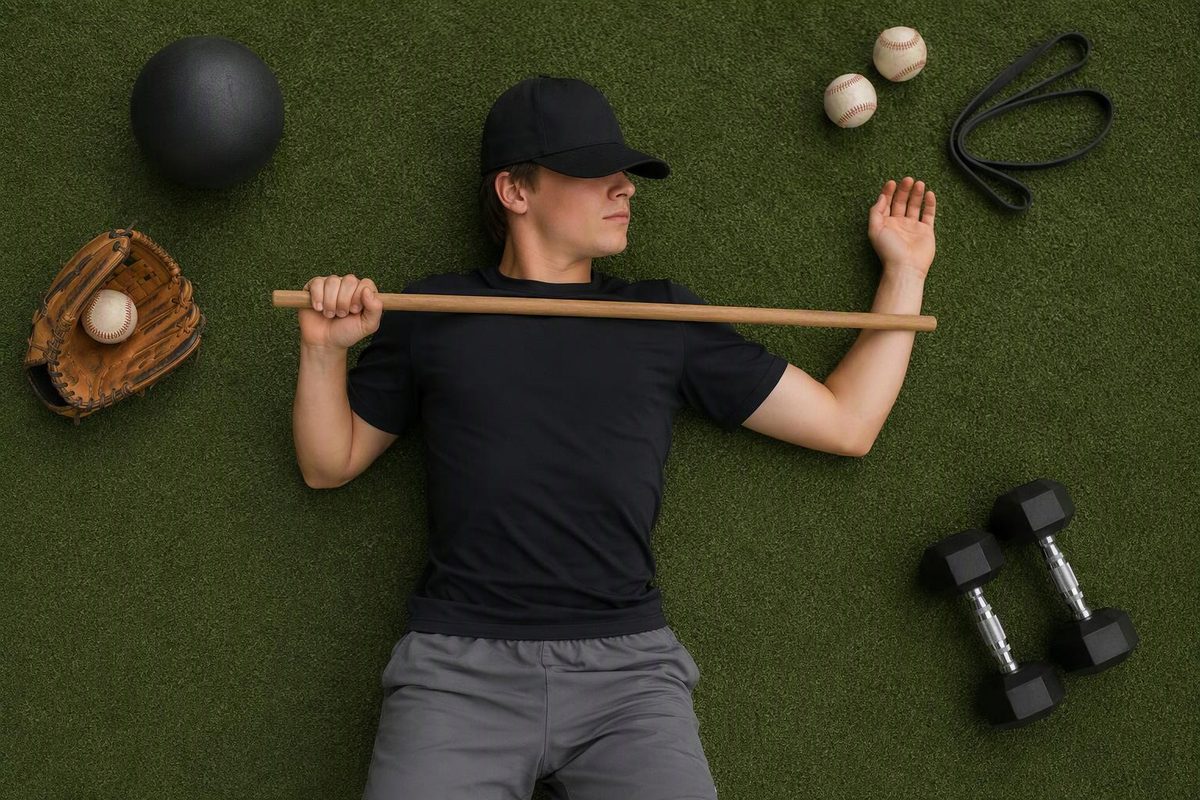
A shoulder external rotation stretch turns the forearm away from the body while the upper arm stays controlled. For a pitcher, the goal is gentle, repeatable motion—not forcing the arm toward the extreme “layback” position seen during a pitch.
Pitchers commonly have more external rotation and less internal rotation in the throwing shoulder than in the nonthrowing shoulder. A study of Major League pitchers found that pattern while also noting similar total rotational motion between sides, so making both shoulders look identical is not a useful goal by itself (Sports Health study).
How to do the stick-assisted stretch
Use a light dowel, yardstick, broom handle or piece of PVC pipe.
- Warm up first. Walk or cycle easily for 5 to 10 minutes. That is the preparation recommended before the AAOS shoulder conditioning program.
- Set the throwing arm. Stand tall with your hips and chest facing forward. Bend the throwing-side elbow to 90 degrees and keep it lightly against your ribs.
- Hold the stick. Cup one end with the throwing-side hand. Hold the other end with the nonthrowing hand.
- Move the forearm outward. Use the nonthrowing hand to push the stick horizontally. The throwing-side hand moves away from the stomach while its elbow remains beside the ribs.
- Stop at a gentle pull. You may feel a stretch at the back of the shoulder. Do not push into pain, pinching or a sense that the joint is slipping.
- Return slowly. Ease off the pressure instead of letting the arm spring back.
Form checkpoint
Viewed from the front, the elbow should stay beside the ribs and the torso should remain square. If the elbow drifts backward, the lower back arches or the body twists, the athlete is creating the appearance of more shoulder motion rather than controlling the stretch.
A small rolled towel between the elbow and ribs can provide feedback: keep it in place without crushing it.
How long should you hold it?
The AAOS program lists four 30-second holds per side, performed five to six days per week. That schedule belongs to a broad shoulder rehabilitation and conditioning program that AAOS says should be selected with a doctor or physical therapist; it is not automatically the right prethrow dose for every healthy pitcher.
Use the volume assigned by the athlete’s clinician or qualified strength coach. If no external rotation work has been prescribed, do not add repeated long holds simply to chase more range. The key standard is a gentle, pain-free stretch with clean position—not how far the hand travels.
What the stretch should—and should not—feel like
The expected sensation is a mild pull at the back of the shoulder. More range is not automatically better. During high-speed throwing, extreme external rotation can stretch structures at the front of the shoulder. Over time, repetitive throwing may contribute to increased looseness, according to the AAOS overview of throwing-related shoulder injuries.
That is why aggressively cranking the arm backward—especially with the elbow raised to shoulder height—is a poor do-it-yourself mobility test.
Stop the stretch if it causes:
- sharp, deep or increasing pain;
- pinching at the front or top of the shoulder;
- numbness or tingling;
- catching, locking or a painful pop;
- a slipping or “dead arm” sensation;
- symptoms that remain after the session.
A pitcher with recent trauma, a previous dislocation, shoulder surgery or a current throwing restriction should follow an individual rehabilitation plan rather than test the shoulder with a generic stretch. Stop throwing and seek a sports-medicine assessment if pain, weakness, loss of motion or a dead-arm feeling develops. AAOS notes that throwing-related shoulder problems can also cause pain at rest or at night, not only while pitching.
Where it fits in a pitching warm-up
This stretch is optional mobility work, not a complete warm-up. A practical progression is:
- whole-body movement;
- gentle shoulder mobility, if needed;
- active shoulder and upper-back exercises;
- easy catch play;
- gradual increases in throwing distance or intent.
The complete sequence is covered in this baseball warm-up routine. After any passive stretch, return to active movement with controlled arm circles or another familiar shoulder-preparation drill. Then build throwing intensity gradually rather than moving directly to full-effort pitches.
Stretching does not erase fatigue or make an excessive workload safe. MLB’s Pitch Smart guidelines use age-based pitch limits and required rest to reduce the likelihood of pitching while fatigued. Parents and players should track workload across leagues and teams, and shoulder or elbow pain is a reason to stop—not something to stretch through.
Do pitchers need more external rotation?
Not necessarily. A player cannot tell from appearance alone whether an apparent restriction comes from the shoulder joint, shoulder blade, upper back, technique or normal individual anatomy. Youth pitchers should not chase the layback position of an older or more flexible teammate.
Use this stretch only as gentle mobility work, not as a velocity drill. If one side suddenly moves less, the athlete cannot throw normally or discomfort returns whenever throwing resumes, the next step is an individual evaluation rather than more force. Shoulder mobility is only one part of arm care; gradual preparation, recovery, workload control and sound throwing mechanics still matter.