
Choose Training Equipment by the Job It Needs to Do
Define the practice problem, feedback, space and supervision first, then select the simplest equipment that performs that job.
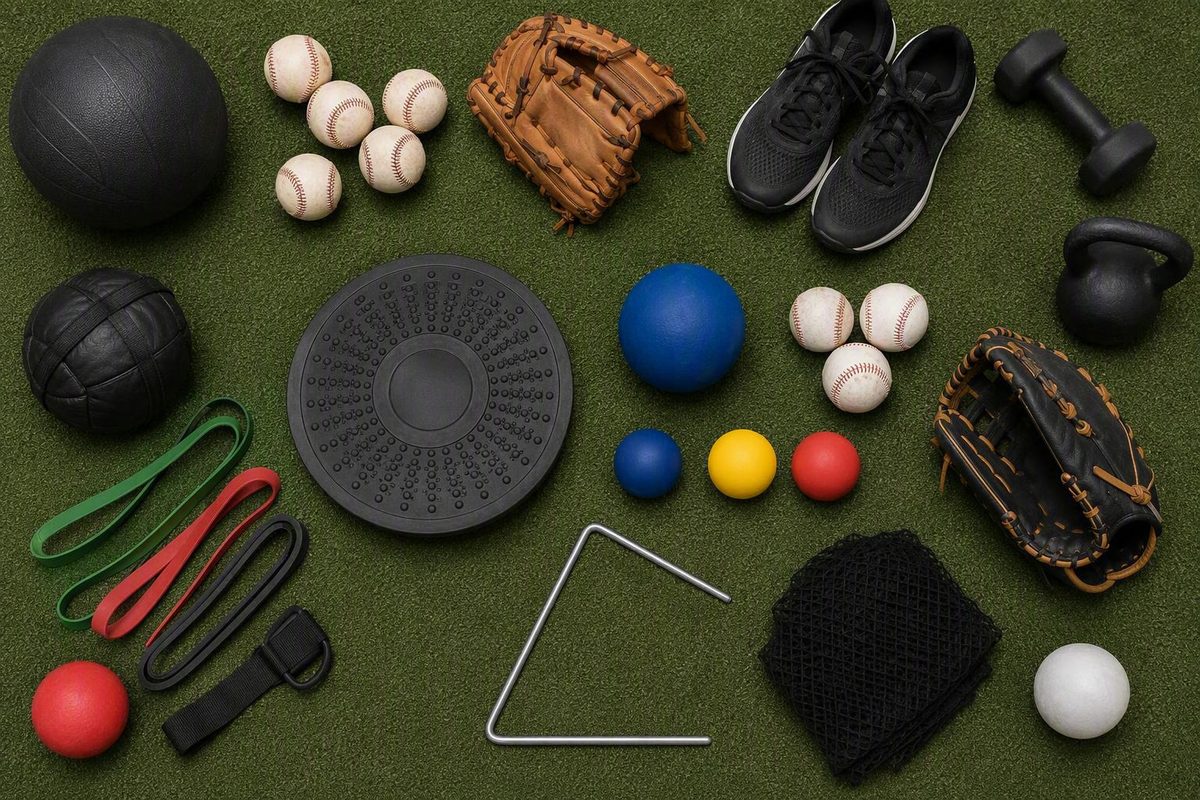
The right baseball training tools solve a defined practice problem, provide feedback the player can understand, fit the available space, and suit the available supervision. Decide whether you need technique feedback, repetition, measurement, resistance, simulation, practice logistics, or protection. Then choose the simplest tool that performs that job. Price, product labels, and marketing claims alone do not establish better results.
Start with the goal, not the gadget
Use five questions to narrow the field:
- What exact skill is being practiced? “Hitting” is too broad; “repeating contact with a stationary outside pitch” is specific enough to guide a purchase.
- Who will use the tool? Consider age, experience, size, handedness, and ability to interpret the feedback.
- Is the session solo or supervised? Some aids reduce dependence on a partner. Others are more useful when a coach can observe the player.
- What space is available? Consult the exact model’s instructions and account for swing or throwing clearance, containment, possible return paths, storage, and nearby people or property.
- What kind of feedback is needed? A tool might provide visual, tactile, resistance-based, numerical, constrained-flight, or simulated-pitch feedback.
These questions separate seven common functions:
- Technique training: makes a movement, position, or swing path easier to feel or see.
- Repetition: presents, returns, delivers, or contains balls so practice can continue efficiently.
- Measurement: reports an outcome such as velocity.
- Resistance or conditioning: changes the load used during an exercise or movement.
- Simulation: repeatedly delivers pitches or adds a batter-like visual.
- Practice logistics: organizes balls, reduces retrieval, or helps operate a station.
- Protection: places a barrier between participants and batted or thrown balls.
Retail catalogs span hitting, throwing, fielding, pitching, catching, agility, accuracy, form, and warm-up. They also separate products into categories such as swing trainers, tees, nets, rebounders, and training balls. These labels describe how equipment is marketed, not whether it will improve the named skill (SKLZ baseball equipment catalog).
Before shopping, write down one problem: “I need to take tee swings without retrieving every ball,” “I need visible targets for bullpen work,” or “I need a consistent way to record pitch velocity.” Apply the same test to catching and agility equipment: identify the task, feedback, space, supervision, and budget before comparing products.
Decision table: match the tool to the practice task
| Goal and tool category | Feedback | Solo-use potential | Space and limitation |
|---|---|---|---|
| Stationary hitting repetition: tee plus net | Contact with a presented ball; the net contains hits | Commonly practical, subject to the model and practice area | Verify full swing clearance and containment. A net does not explain why contact changed. |
| Swing-path work: swing trainer | Visual, tactile, or constraint-based | Varies by design; coaching may help interpret the response | Confirm attachment and movement requirements. The aid can reveal or constrain movement but does not diagnose a swing. |
| Pitch-location practice: marked target net | Visual aiming zones | May reduce dependence on a catcher | Verify throwing clearance under the model instructions. Practice target results do not guarantee game command. |
| Velocity measurement: radar | Numerical outcome | May be operated solo depending on the model | Placement, angle, distance, mode, and procedure affect comparisons. Radar does not explain mechanics. |
| Repeated pitch or reaction work: pitching machine or small-ball delivery system | Repeated simulated pitches | Often possible once the equipment is set up appropriately | Confirm containment, compatible balls, power, and operating requirements. Machine delivery differs from live pitching. |
| Defensive repetition: rebounder or fielding trainer | Return direction and repeated handling opportunities | Often designed to reduce dependence on a partner | Check the expected return area and model instructions. The tool supplies repetitions, not coaching analysis. |
| Practice protection or logistics: L-screen, net, or ball cart | No direct technique feedback | Depends on the activity and required supervision | These products support separation, containment, or organization rather than teaching mechanics. |
A category can serve more than one task, but its primary function still matters. A net behind a tee can reduce retrieval without telling the hitter why contact quality changed. Radar adds a number without supplying a mechanical explanation.
Hitting tools: repetition, swing feedback, and pitch simulation
Containment nets collect batted balls.
Attached-ball trainers retain or return the ball through a tethered mechanism. Their practical advantage is convenience: the hitter may avoid chasing balls and repeatedly reloading a tee. One anecdotal review praised that efficiency while noting that the system did not show normal ball flight. The reviewer also relayed an unverified concern about tether wear, so durability should be treated as a warranty and replacement-parts question rather than an established defect (Baseball Notes review of youth training aids).
Swing-path trainers may attach to the bat or body, create a visible reference, or constrain a movement. Before buying one, ask whether an experienced coach has identified a problem that the tool’s feedback can address. Feeling or seeing a constraint does not determine when a mechanical change is appropriate.
Constrained-flight or heavy impact balls are designed to travel less than standard baseballs when struck. That can make some drills easier to contain, but the resulting flight is not normal ball-flight feedback.
Small training balls and delivery systems provide repeated hitting or reaction opportunities. Confirm which balls the machine accepts rather than assuming standard baseballs, mini balls, foam balls, and manufacturer-specific balls are interchangeable.
Weighted bats change the implement used for a swing. Heavy training balls change the object being struck and its resulting travel. Retail listings establish that both categories are sold for training, but they do not establish a suitable weight, workload, or progression for every player.
Before buying a hitting system, verify:
- Required swing and ball-flight clearance under the model instructions
- Intended containment and return area
- Electrical, charging, or battery requirements
- Compatible ball type and size
- Availability and cost of balls, tethers, nets, and attachments
- Assembly, transport, and storage requirements
Pitching and throwing tools: command, simulation, and measurement
Pitching equipment includes target nets, batter dummies, radar devices, spin trainers, leg-drive trainers, weighted balls, portable mats, and shoulder-training tools. These categories describe intended practice functions; they do not by themselves demonstrate changes in velocity, command, mechanics, or arm health.
A nine-zone target gives the pitcher visible locations and may allow practice without a catcher. A batter dummy changes the visual scenario by occupying part of the plate area and may be positioned to represent different batter locations. Neither reproduces the decisions and consequences of competition. Both are documented among current pitching-aid categories (Anytime Baseball Supply pitching aids).
Radar reports velocity. It does not explain why a reading changed, diagnose delivery mechanics, or determine whether pursuing a higher number is appropriate. An anecdotal review reported occasional inconsistent readings and identified angle as a factor. If radar is used, keep the setup and procedure consistent and compare like-for-like readings rather than reacting to one maximum.
Those observable functions should not be converted into unsupported promises of better command or higher velocity.
Pitcher’s Helmet’s stated editorial approach puts command and mechanics before velocity and arm care before other development priorities. It also says its information cannot replace a coach or doctor who can evaluate the individual pitcher (Pitcher’s Helmet development approach). For youth players, an experienced coach should evaluate training suitability and mechanics; a responsible adult should supervise the practice environment; and pain or health concerns belong with an appropriate medical professional.
Choose for home, solo, team, or facility use
Choose according to what remains observable: contact point, target location, return direction, or a movement constraint.
In a garage or small yard, verify the complete operating area against the exact model’s instructions. Ask whether there is enough room for the intended movement, where a miss or returned ball could travel, what the equipment is designed to contain, and what lies around the practice area. Constrained-flight and tethered systems may reduce ordinary ball travel, but they provide less information about normal flight.
For a coached or team session, distinguish individual technique aids from shared station equipment. A swing trainer may give one player movement feedback. A pitching machine, protective screen, ball cart, or large net instead supports repeated delivery, participant separation, organization, or containment. Those functions can make a session easier to operate without directly teaching technique.
Schools, leagues, and facilities should consider operating demands as well as purchase price:
- Who will assemble, adjust, and maintain the equipment according to its instructions?
- Can it be transported between fields?
- Where will it be stored?
- Are replacement nets, wheels, balls, tethers, or hardware available?
- Does it require power or charging?
- Which baseball or softball sizes are compatible?
- Is purchasing support available for an institutional order?
Do not infer a required distance or protective arrangement from a category name. Check the instructions for the exact model and determine whether the proposed practice area can meet them.
Set a budget by function
Think in non-prescriptive tiers:
- Low-cost: grips, standard accessories, impact balls, and other training balls
- Midrange: targets, rebounders, and specialized swing or fielding trainers
- Premium: radar devices, large screens, attached-ball systems, and pitching machines
As displayed by MaxBP on September 8, 2026, a bat grip was listed at $16, while pitching machines started at $590 and $790. These were retailer-listed prices, not market averages (MaxBP batting equipment collection).
On the same date, the SKLZ catalog displayed impact practice baseballs at $24.99, a small-ball trainer at $89.99, and a fielding trainer at $99.99 (SKLZ baseball equipment catalog).
Pitching examples displayed by Anytime Baseball Supply on September 8, 2026, included a command target at $249.99 and a radar device at $329.99 (Anytime Baseball Supply pitching aids).
HittingStore displayed an attached-ball hitting trainer at $399 on the same date (HittingStore training equipment). Prices, inventory, discounts, shipping terms, and availability can change, so verify the current listing before ordering.
Before purchasing a specialized system, test the underlying training concept with ordinary equipment where practical—for example, a standard tee and net before an attached-ball station, or simple visual markers before a premium command target.
Include ownership costs in the comparison.
Use a pre-purchase checklist before trusting the marketing
Confirm each of the following before buying:
- [ ] The exact practice task the tool must support
- [ ] Player age, experience, size, handedness, and ability to interpret the feedback
- [ ] Coach input when the purchase addresses a mechanical issue
- [ ] Whether solo use is practical or supervision is required
- [ ] Clearance and containment requirements stated for the exact model
- [ ] Setup time, assembly requirements, portability, and storage dimensions
- [ ] Electrical power, charging, or battery needs
- [ ] Compatible bats, balls, attachments, sports, and machine settings
- [ ] Consumable and replacement-part availability
- [ ] Warranty coverage and return conditions
- [ ] Current stock, price, shipping cost, and delivery terms
Next, identify the feedback. Is it visual, tactile, resistance-based, numerical, constrained-flight, or simulated-pitch feedback? If that answer is unclear, it will be difficult to design a useful drill or evaluate the purchase.
Separate observable functions from performance promises. A device may demonstrably hold, contain, return, deliver, constrain, or measure a ball. Product names, seller-hosted reviews, testimonials, and labels such as “youth” or “all skill levels” do not establish universal suitability or transfer to games.
For youth use of weighted balls, weighted bats, resistance tools, pitching machines, or velocity-focused throwing, seek the appropriate form of oversight: an experienced coach for training and mechanical decisions, responsible adult supervision for the practice setting, and an appropriate medical professional when pain or health concerns arise.
Finally, decide how progress will be evaluated after the aid is removed and practice becomes more game-like. Choose the smallest, simplest tool that solves the defined problem, then judge it by the useful feedback and repetitions it makes possible.
Do expensive baseball training tools work better than basic equipment?
Not necessarily. Basic equipment may be enough when the task is presenting a stationary ball, containing hits, or marking a target. Compare function, feedback, frequency of use, ownership cost, and performance after the aid is removed rather than assuming price predicts results.
Are weighted baseballs and weighted bats appropriate for youth players?
A youth label or retailer listing does not establish that a particular weight, drill, workload, or intensity is appropriate for every young player. Do not create a throwing or hitting program from the product name alone. An experienced coach can assess training suitability and mechanics, while pain or health concerns should be evaluated by an appropriate medical professional.
What should I check before buying a used training tool?
Confirm the exact model, original instructions, compatible balls or attachments, power requirements, included and missing parts, replacement-part availability, and remaining warranty or service options. Ask whether the manufacturer provides current operating documentation for that model. Include missing parts, transport, and any professional inspection or service in the total cost before comparing the used item with a new one.