
A Pitcher’s Evidence-Aware Guide to Weighted Throwing Tools
Compare dimensions, construction, impact instructions, warranties, and replacement support, then match each option to a defined, supervised drill.
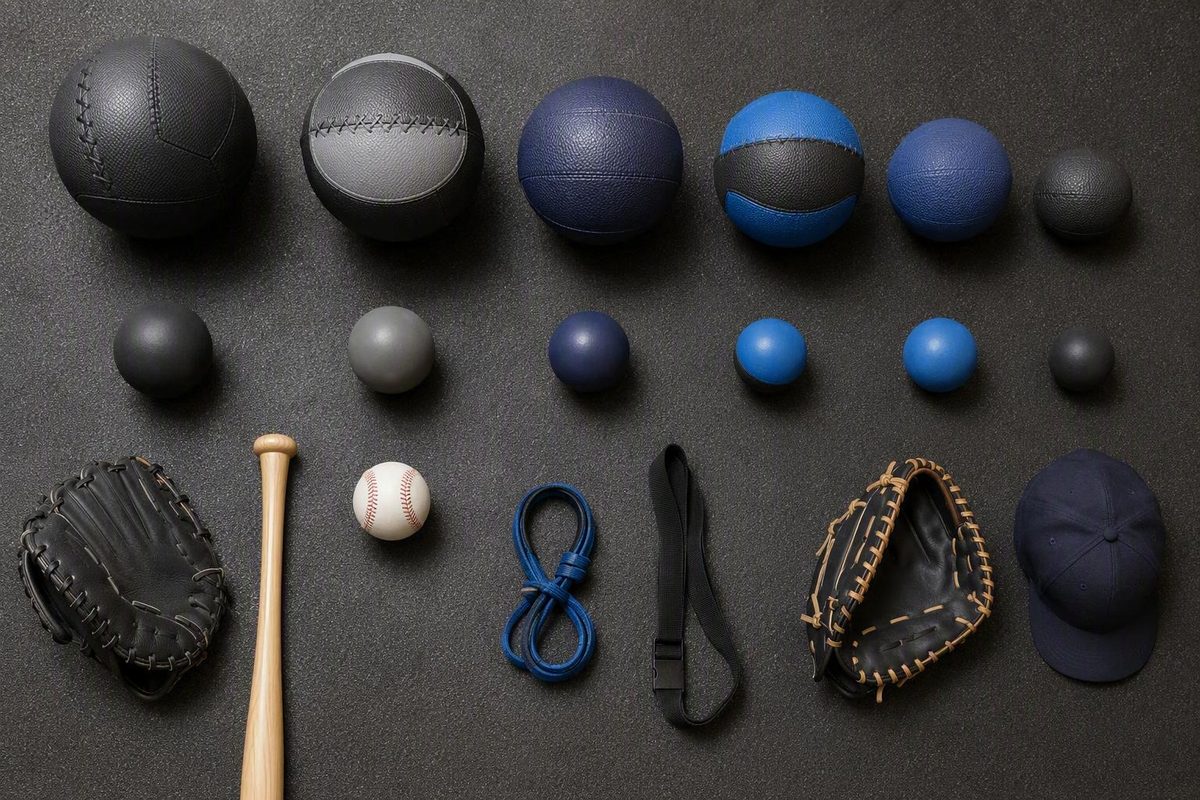
Plyo balls are easy to buy and surprisingly difficult to evaluate. A set may contain several bright colors and promise more velocity, cleaner mechanics, better command, or a healthier arm. Yet the purchase page may omit circumference, fill, replacement options, impact instructions, or meaningful workload guidance.
The practical question is not simply, “Which plyo balls are best?” It is: Which verified specifications match a defined drill and supervised training purpose—and what uncertainties remain?
Plyo balls can be compared by weight spread, circumference, construction, wall-use instructions, warranty, and replacement cost. Those facts do not guarantee a training result. The demand of any throw also depends on the drill, effort, repetitions, weekly workload, mechanics, and individual athlete.
What Plyo Balls Are—and Why the Terminology Is Confusing
In baseball training, a plyo ball is generally a pliable weighted throwing implement. Many have a rubber- or PVC-style shell and a sand-like fill, but construction varies. Products can differ in shell material, fill, circumference, seams, grip, rebound, and degree of deformation. RP Performance, for example, defines plyo balls as rubber-coated weighted balls filled with sand-like material, while commercial sets use different designs and descriptions (RP Performance’s plyoball guide).
There is no consistently applied industry definition separating a “plyo ball” from a “weighted baseball.” Some retailers reserve plyo ball for soft-shell implements and weighted baseball for firm, baseball-shaped tools. Coaches and researchers may instead discuss pliable plyo balls within the broader category of weighted-ball training. The label alone therefore does not establish how an implement behaves or how it should be used.
A useful way to interpret weight is relative to a 5-ounce baseball:
- Underload: lighter than 5 oz
- Regulation-like: approximately 5 oz
- Overload: heavier than 5 oz
- Extreme overload: substantially heavier, often measured in pounds rather than a few additional ounces
These categories describe mass relative to a baseball. They do not guarantee a particular adaptation. “Underload” does not automatically mean greater arm speed, and “overload” does not automatically mean greater strength. The athlete still performs a particular movement at a particular effort and volume.
Do not assume that plyo balls occupy a standard 4-to-8-ounce range. That range appears in some retailer guidance, but the products and coaching protocols in the available evidence extend from approximately 3.5 ounces to 2 pounds. The discrepancy reflects inconsistent terminology rather than a dependable product standard.
Common weight conversions
| Listed weight | Approximate grams | Relative to a 5 oz baseball |
|---|---|---|
| 3.5 oz | 99 g | Underload |
| 4 oz | 113 g | Underload |
| 5 oz | 142 g | Regulation-like |
| 5.25 oz | 149 g | Near regulation |
| 7 oz | 198 g | Overload |
| 9 oz | 255 g | Overload |
| 10 oz | 284 g | Overload |
| 15 oz | 425 g | Overload |
| 16 oz / 1 lb | 454 g | Extreme overload |
| 20 oz | 567 g | Extreme overload |
| 32 oz / 2 lb | 907 g | Extreme overload |
Conversions are rounded to the nearest gram. Programs labeled in grams may use 100 g, 150 g, 225 g, or 450 g rather than exact ounce equivalents.
A pliable shell can change grip, deformation, rebound, and impact behavior. It does not make the throwing load disappear. The available evidence also does not establish that a soft-shell ball produces less shoulder or elbow loading than a firm weighted baseball of equal mass. That remains an important unanswered biomechanical question.
The purchasing implication is straightforward: look beyond the category name. Verify the implement’s mass, circumference, construction, intended impact surface, and place in the planned drill.
What Different Weights Change in a Throwing Session
Changing ball weight changes the task, but weight is only one variable. A controlled kneeling reverse throw, a moderate-effort Marshall, and a high-intent run-and-gun throw are not equivalent exposures merely because they use the same ball.
Practitioners commonly describe lighter implements as emphasizing speed and coordination, while heavier implements place greater demands on the muscles controlling the arm. This is a coaching framework, not proof that a given ball will produce a specific adaptation. Premier Pitching’s guidance also notes that responses may vary with anatomy, mechanics, training background, workload, and recovery (Premier Pitching’s practitioner overview).
Weight cannot be separated from intent
It helps to divide use into two broad categories:
- Low-intent warm-up or movement work. The athlete uses controlled effort to rehearse a position, rhythm, or movement cue.
- Moderate- or high-intent performance work. The athlete throws with more speed, momentum, or competitive intent, often in drills intended to challenge velocity or sequencing.
Calling both activities “plyo work” hides a meaningful difference. High intent can increase the overall demand even when the selected ball is not especially heavy. Conversely, a very heavy ball moved at low effort is not interchangeable with a lighter ball thrown aggressively.
Drill position matters as well. A kneeling throw constrains the lower body; a step-behind or run-and-gun throw adds momentum. Distance, direction, number of repetitions, proximity to other throwing, and the athlete’s familiarity with the movement further shape the exposure.
Why heavier is not automatically better
Research summarized by Mike Reinold reported greater elbow varus torque in particular flat-ground weighted-ball conditions, including run-and-gun throwing, and increasing elbow stress with increasing ball weight in a youth flat-ground study. The same summary reported immediate increases in shoulder external rotation after overload and extreme-overload sessions (Reinold’s research summary).
These findings do not establish that every heavy throw is harmful. They do show why “more load equals more benefit” is an inadequate selection rule. An immediate range-of-motion change is not necessarily a useful long-term adaptation, and it is not by itself proof of future injury.
The source available for these findings is an expert secondary summary rather than the complete primary reports. Exact methods, implement types, definitions, and subgroup results should be checked against the underlying studies before the figures are used to design a program.
There is no universal starting weight
Published practitioner suggestions conflict. Premier Pitching says many programs begin with 7-to-9-ounce balls while also advising athletes to start closer to a 5-ounce baseball at low effort. RP Performance suggests that beginners purchase 150 g and 450 g balls.
Under the framework used in this guide, 450 g is approximately 16 ounces and therefore an extreme-overload implement—not a moderate-overload ball. That pairing is one training provider’s example, not a validated beginner prescription for every pitcher.
A better selection sequence is:
- Identify the drill.
- Identify the intended coaching cue.
- Decide whether the session is warm-up, skill work, or high-intent performance work.
- Assess the athlete’s readiness, mechanics, training history, symptoms, and current workload.
- Have a qualified coach choose the weight, effort, repetitions, and frequency together.
- Reassess the athlete’s execution and response before progressing.
The ball should serve the drill. The athlete should not invent a drill merely because a heavier ball came in the box.
The Buying Checklist: Features That Matter More Than Marketing
The strongest purchase decision is usually based on ordinary specifications, not the boldest performance promise.
1. Permanent, unmistakable weight labels
Every ball should have its weight clearly marked in a way that remains legible. Color coding can help, but color alone is unreliable: colors differ between brands, and some sellers warn that delivered colors may vary from product images.
Printed mass matters more than color.
2. Actual weight spread
Count useful weights, not colors. Determine whether the set contains:
- an underload ball;
- a regulation-like ball;
- one or more moderate-overload balls;
- an extreme-overload ball.
Then ask whether the assigned program uses each category. Six balls are not automatically more useful than two. A set may provide greater theoretical versatility while including loads the athlete should not currently use.
3. Circumference
Mass is not the only dimension affecting the task.
SKLZ provides a concrete example: its 3.5-, 5.25-, 10-, and 15-ounce balls are listed with 9-inch circumferences, while its 20-ounce ball is listed at 12 inches. That makes the heaviest ball different in both mass and size.
If a seller provides weight but omits circumference, the comparison is incomplete.
4. Shell, fill, seams, and feedback
Check whether the seller identifies:
- shell material;
- fill material;
- seams or another grip feature;
- pliability and expected deformation;
- rebound behavior;
- impact-surface restrictions.
Some pliable balls display a temporary mark or flattened area at the point of wall contact. That may provide visible contact feedback. The available evidence does not show that the mark improves mechanics, accuracy, or learning.
5. Explicit wall or net approval
Never infer that a soft ball is approved for repeated wall impact. Look for explicit manufacturer instructions permitting wall or net throws, along with any surface restrictions and inspection guidance.
A product approved for net use may not be approved for concrete, brick, painted drywall, or another hard surface. The throwing area must also protect other people, property, and the athlete from missed throws or unpredictable rebounds.
6. Warranty and replacements
A lower set price can become less attractive if one damaged or missing ball requires replacement of the whole set. Compare:
- warranty length;
- warranty exclusions;
- whether individual weights are sold;
- the price of a single replacement;
- whether the replacement matches the original circumference and construction.
7. Missing specifications
Missing information is decision-relevant. If a listing does not disclose mass, dimensions, shell, fill, approved use surface, or warranty, do not fill the gaps using product photographs or another brand’s specifications. Ask the seller before ordering.
8. Evidence behind quality and performance claims
Claims such as “professional grade,” “built to last,” and “proven results” require independent testing to support meaningful comparisons. The available product pages do not provide a controlled durability comparison, so this evidence cannot establish that one brand is more durable.
Marketplace stars, review counts, recent purchase counts, sponsored placements, and merchandising badges are also limited signals. They may indicate visibility or customer activity. They do not establish training effectiveness, injury safety, manufacturing consistency, or long-term durability.
Plyo-Ball Set Comparison: Verified Specifications and Missing Details
This is a limited comparison of documentation available for four visible options, not a comprehensive market ranking. The supplied snapshots do not include a reliable common capture date. Prices, ratings, review totals, badges, availability, and seller terms must therefore be reverified immediately before purchase or publication.
| Product | Listed snapshot price | Ball count | Verified or apparent weights | Circumference | Shell or fill | Wall or net guidance | Warranty | Single-ball availability | Important unknowns |
|---|---|---|---|---|---|---|---|---|---|
| SKLZ Throwing Plyo Balls | $54.99 | 5 | 3.5, 5.25, 10, 15, and 20 oz | 9 in for first four; 12 in for 20 oz | 74.2% iron sand; 25.8% PVC | Manufacturer permits wall or net use; weight-specific drills included | 1 year | Not established on available page | Replacement pricing, age limits, workload guidance, independent durability data (SKLZ specifications) |
| Premier Pitching Plyo Ball Set | $65 | 6 | Apparently 3.5, 5, 7, 9, and 16 oz plus 2 lb; inferred from imagery and related listings | Not stated | PVC shell; fill not stated | Not established | Not stated | Yes; $13 each | Exact set contents require confirmation; dimensions, fill, warranty, age guidance, and use instructions are missing (Premier Pitching set listing) |
| GoSports six-pack | $35.99 | 6 | Unverified in the available marketplace snapshot | Unverified | Unverified | Unverified | Unverified | Unverified | Weights, construction, dimensions, use guidance, warranty, and replacements; snapshot showed 4.8 stars from 620 ratings and an Amazon merchandising label using “Overall Pick” wording (Amazon search snapshot) |
| Marv Balls Velo Set | $57.99 | Set count not verified on collection page | Unavailable from collection page | Unavailable | Unavailable | Unavailable | Unavailable | Yes; singles from $10.99 | Set weights and count, materials, dimensions, wall-use guidance, and warranty (Marv Balls collection) |
SKLZ supplies the most complete specification sheet among these four options. Its page identifies all five weights, both circumferences, material percentages, intended wall or net use, included weight-specific drills, and a one-year warranty. That makes the set easier to evaluate; it does not prove that it is safer, more effective, or more durable.
Premier Pitching lists a six-ball PVC-shell set and individual balls. The apparent sequence—3.5, 5, 7, 9, and 16 ounces plus 2 pounds—is inferred from product imagery and related individual listings rather than explicitly enumerated in the main description. Buyers should confirm the contents directly.
The Amazon snapshot displayed a GoSports six-pack with a price, rating total, and merchandising badge. Those details describe a marketplace listing at one moment. They do not answer the technical and training questions left open by the listing, and the generic search page may no longer reproduce the same results.
Marv’s collection page listed a Velo Set and individual balls but did not disclose the set’s weights, construction, circumference, wall instructions, or warranty. A technical comparison is therefore not yet possible.
There is no defensible “best overall” choice from this evidence. Instead:
- Buyers prioritizing documented dimensions, materials, intended impact use, and warranty can evaluate SKLZ most fully.
- Buyers considering Premier appear to receive a broader weight range but should confirm the inferred contents and missing use instructions.
- GoSports requires verification of weights, construction, dimensions, impact approval, warranty, and replacements.
- Marv requires confirmation of set contents and most technical specifications.
Completeness of documentation is not proof of superior performance, but it reduces avoidable uncertainty.
Complete Set or Individual Balls?
A beginner does not automatically need a complete set. The correct purchase depends on an existing coach-directed program and the loads that program actually uses.
When a complete set makes sense
A set can support several drill and loading options without repeated purchases. That is useful when:
- a coach has assigned a progression;
- every included ball has a defined role;
- labels and construction are consistent;
- the athlete is likely to use the range over time;
- replacement and warranty terms are acceptable.
That advantage disappears if half the set remains unused.
When a set creates unnecessary risk or expense
Do not purchase a 1- or 2-pound ball solely because it is included. Buy one only if a qualified coach has defined its purpose, execution, effort, volume, and place in the weekly throwing plan.
When individual balls make sense
In the supplied seller snapshots, Premier listed individual balls at $13, Amazon displayed one Premier ball at $12.99, and Marv listed singles from $10.99. These are dynamic commercial figures, so current shipping, taxes, availability, and product specifications should be checked along with sticker price.
RP Performance suggests that beginners buy a 150 g ball and a 450 g ball. The first is close to baseball weight; the second is approximately 16 ounces and qualifies as extreme overload under this guide’s categories. This is a practitioner’s instructional example—not a universal starter setup or evidence that a beginner should throw a 450 g ball.
A regulation-like ball plus another coach-selected load may cover a limited instructional plan, but only when those are the implements the coach intends to use.
Questions to answer before buying
- Which drills has the coach assigned?
- What weights do those drills require?
- Is each drill low intent, moderate intent, or high intent?
- Is the athlete currently prepared for the planned work?
- Can the product be used with the available wall or net?
- Is that impact surface expressly permitted by the manufacturer?
- Are individual replacement balls available?
- What does the warranty cover?
- Are circumference, shell, and fill disclosed?
- How will these throws be counted in the athlete’s total workload?
- Does the set include extreme weights with no current purpose?
If those questions cannot be answered, delay the purchase. Owning more loading options is not the same as having a better program.
Common Plyo-Ball Drills and Their Intended Coaching Focus
Plyo-ball drills are often presented as tools for teaching movement. The descriptions below summarize practitioner intent; they do not establish that a drill produces the claimed adaptation or prevents injury.
| Drill | Basic setup | Intended practitioner cue | Loading reported in available guidance | Common execution errors | Evidence quality |
|---|---|---|---|---|---|
| Reverse throw | Often kneeling or in a stable 90-90 position, facing away from the wall; move from a simulated release position backward into the throw | Posterior-shoulder work, trunk rotation, stacking, or deceleration | RPP: 1–2 sets of 10 with 1- or 2-lb balls | Beginning too far forward, collapsing the front knee, rotating from the hips rather than the torso, changing the prescribed hand orientation | Coaching recommendation |
| Rocker throw | Wide stance with controlled rocking or loading before rotating and throwing | Back-leg loading, rhythm, hip rotation, trunk rotation, or stacking | Varies by program | Rushing the rock, losing posture, drifting instead of loading, opening early | Coaching recommendation |
| Pivot pickoff | Compact stance with a pivot and quick rotational throw toward the target | Hip and torso rotation, sequencing | No universal load established | Spinning without control, pulling the glove side, opening the trunk early, exceeding the assigned effort | Coaching recommendation |
| Marshall | Constrained lower body with emphasis on arm action and position through the throw | Arm action, glove-side integrity, arm position near foot strike | RPP: 1–2 sets of 10 with 1- or 2-lb balls at 60–70% perceived effort | Excessive effort, poor glove-side control, losing arm position, turning a constrained drill into a full-body throw | Coaching recommendation |
| Walking torque | Walk or roll into a rotational throw, organizing the upper body over a moving lower half | Upper-body mechanics, hip–shoulder separation, pelvis timing, lead-leg action | RPP reports no more than 9 oz; sets vary | Rushing, opening the shoulders early, poor lead-leg control, losing posture | Coaching recommendation |
| Step-behind throw | Use a step-behind pattern to create lateral momentum before throwing | Pelvis-rotation timing, hip–shoulder separation, lateral trunk position | RPP reports no more than 9 oz; sets vary | Uncontrolled momentum, poor direction, early trunk rotation, treating every repetition as maximal | Coaching recommendation |
| Step-back throw | Step backward to create movement, then transition forward and throw | Momentum, center-of-mass transition, athletic movement, lower-to-upper-body timing | RPP reports no more than 9 oz; sets vary | Excessive speed, unstable direction, late organization, advancing immediately to high intent | Coaching recommendation |
RPP’s published loading deserves special caution. Its guide reports 1–2 sets of 10 with 1- or 2-pound balls for reverse throws and Marshalls, with Marshalls at 60–70% perceived effort. Those figures are examples from RPP’s own programming and coaching experience—not general recommendations or validated prescriptions for all pitchers (RPP’s plyo-ball drill guide).
Reverse throws
Coaches commonly use reverse throws to cue posterior-shoulder involvement, trunk counter-rotation, stacked posture, or deceleration. The drill is often constrained so the athlete cannot rely on a complete pitching delivery.
That intended focus does not mean reverse throws have been proven to prevent shoulder or elbow injuries. It also does not mean a heavy ball is necessary for every athlete. Position, effort, control, and the athlete’s current workload matter.
Rocker throws and pivot pickoffs
Rocker throws use rhythmic movement to help the athlete feel loading and rotation. Pivot pickoffs use a compact rotational action to emphasize how the lower body and trunk sequence into the throw.
Both can be performed poorly. More movement can become sway; faster rotation can become early opening. A coach should decide whether the ball and drill clarify the targeted movement or merely add complexity.
Marshalls
Marshalls constrain parts of the delivery so the coach can focus on arm action, glove-side behavior, or the position of the arm near foot strike. Because some published versions use substantial overload, athletes should not copy the listed pounds and repetitions without individualized instruction.
Walking torques
Practitioners use walking torques to combine movement into the throw with upper-body organization. Common coaching themes include hip–shoulder separation, pelvis timing, and lead-leg action. These are intended cues, not independently validated outcomes.
Step-behind throws
The step-behind adds momentum and coordination demands. Coaches may use it to address pelvis timing or sequencing between the lower and upper body.
Step-back throws
Step-back throws introduce momentum and a transition from backward movement into forward force. Practitioners associate them with center-of-mass control and lower-to-upper-body timing.
Some guides also associate the drill with high intent. That changes the exposure. A low-effort introduction and an aggressive velocity throw should not share the same workload label.
The available evidence does not establish one correct drill order, set count, intensity, or weight for every pitcher. Even when two programs use the same drill name, execution and purpose may differ. Athletes should learn the version their coach intends rather than combining cues and loading recommendations from several sources.
Do Plyo Balls Improve Velocity—and What Does the Research Say About Risk?
Three kinds of claims often appear together in discussions of plyo balls:
- Manufacturer claims: statements intended to sell a product.
- Practitioner observations: coaching judgments based on experience.
- Research findings: results from a defined sample, protocol, and method.
They should not carry equal weight.
What sellers claim
Product pages commonly associate plyo balls with velocity, mechanics, command, strength, recovery, accuracy, or arm health. The supplied pages do not provide controlled product comparisons demonstrating those outcomes.
A product’s listed material and weight can be checked against its specification sheet. A promise of better command or a healthier arm cannot.
What the high-school intervention reported
An expert research summary describes a six-week weighted-ball intervention in high-school pitchers. The weighted-ball group reportedly gained 3.3% in average pitching velocity and had a 24% injury rate, while the control group had no injuries. It also reports that 67% of the control group increased velocity through ordinary throwing and weight training.
This supports only a narrow conclusion: that the particular program was associated with an average velocity gain and injuries in that studied population. It does not show that every plyo-ball drill raises velocity, that every program carries the same injury rate, or that a soft-shell ball has the same effects as every firm weighted baseball.
The control result matters too. Specialized weighted-ball training has not been established as necessary for velocity improvement.
Because these figures are available here through a secondary research summary, readers designing or formally evaluating programs should consult the complete primary study for participant characteristics, injury definitions, implement types, progression, and statistical methods.
Immediate shoulder-motion findings
The same research summary describes an acute study of 16 high-school pitchers with a mean age of 17. Following overload throwing, shoulder external rotation reportedly increased by more than 3 degrees; after extreme-overload throwing, the mean increase was 8.8 degrees.
That is an immediate range-of-motion finding. It is neither proof of a beneficial adaptation nor proof that the athlete will later be injured. Acute changes can help describe what happened after a session, but long-term benefit and long-term harm require different evidence.
The conditions also matter. The study used particular weights, throwing positions, and session structures. Its findings should not be transferred indiscriminately to every warm-up toss, pliable ball, or weighted-ball program.
The 2025 professional-pitcher cohort
A preliminary 2025 prospective cohort followed 88 pitchers from one professional organization: 46 regular weighted-ball users and 42 nonusers. The study observed higher arm and trunk/core injury rates among users.
Reported arm injury rates were 11.8 versus 7.5 per 1,000 exposures, and reported trunk injury rates were 5.9 versus 2.1. The available article uses inconsistent denominator wording—alternating between “game exposures” and “athlete exposure days”—so that detail should be checked before the rates are reused or compared with other research (2025 preliminary professional-pitcher cohort).
The study does not prove weighted balls caused the injuries. Important limitations include:
- weighted-ball use was voluntary rather than randomized;
- use and previous exposure were self-reported;
- programs differed in weights, purposes, and training habits;
- the sample was small;
- all participants came from one organization;
- other differences between users and nonusers may have affected injury risk;
- the analysis was preliminary and observational.
The association deserves attention, especially alongside evidence that some weighted-ball conditions alter measured joint loading or shoulder motion. Causation cannot be assigned from this design.
What the evidence does—and does not—support
The evidence does not prove that plyo balls are universally safe. “Soft” is not a safety guarantee, and a low-intent warm-up protocol cannot validate a high-intent velocity program.
The evidence also does not prove that every plyo-ball program causes injury. Products, drills, weights, effort, volume, populations, preparation, and recovery vary too widely for that conclusion.
A balanced reading is:
- velocity gains are possible but not guaranteed;
- specialized balls are not established as necessary for velocity gains;
- some weighted-ball conditions have produced greater measured elbow loading or immediate shoulder external rotation;
- injury signals have appeared in both intervention and observational evidence;
- the evidence does not provide a universal safe dose;
- individualized programming and conservative risk management remain necessary.
A Conservative Safety and Readiness Checklist
This checklist is a risk-management framework. It is not a validated universal protocol, medical clearance, diagnosis, or personalized throwing program.
Before the first session
Consider:
- current shoulder, elbow, forearm, wrist, back, or trunk pain;
- recent changes in throwing volume or intensity;
- games, bullpens, long toss, lessons, and team practices;
- previous throwing-related injury;
- current mechanics and ability to perform the drill without added load;
- general training history and maturity;
- fatigue and recovery;
- whether a qualified coach can observe the movement;
- whether current or previous symptoms warrant evaluation by a sports-medicine professional.
Introduce the drill before chasing load
Begin with a total-body warm-up and throwing-specific preparation. When introducing an unfamiliar drill, a conservative practitioner approach is to use a ball close to regulation weight at low perceived effort. Premier Pitching’s guidance similarly recommends beginning closer to a 5-ounce baseball, using lower initial effort, monitoring weekly throwing volume, and progressing according to the athlete’s response.
The first exposure should be used to understand the movement and establish control—not to test the heaviest implement available.
Change one major variable at a time
The main variables include:
- ball weight;
- throwing effort;
- repetitions;
- sets;
- drill complexity;
- weekly frequency;
- momentum or run-up;
- distance;
- proximity to other demanding throwing.
A heavier ball, more aggressive drill, extra set, and additional weekly session should not all be introduced at once. Practitioner guidance supports gradual loading, lower initial effort, workload monitoring, and individualized adjustment rather than a fixed progression for everyone (Premier Pitching’s progression guidance).
Count every throw
Plyo throws are part of the athlete’s total throwing volume. They are not free repetitions because they occur during “warm-up.”
Track them alongside:
- catch play;
- long toss;
- bullpens;
- game pitches;
- pickoffs;
- fielding throws;
- velocity work;
- other weighted-ball work.
Separate warm-up from high-intent work
Label sessions accurately. Controlled preparatory throws are different from moderate- or high-intent performance work.
Demanding sessions need to be considered alongside games, bullpens, other throwing, and strength training.
Stop for pain or concerning symptoms
Stop the session if pain or concerning symptoms occur. Do not attempt to solve pain by changing ball color, switching drills, lowering the weight for a few throws, or modifying mechanics without appropriate evaluation.
Seek qualified medical assessment rather than relying on internet guidance to identify the cause of an individual athlete’s symptoms. Retailer and practitioner guidance in the evidence also recommends gradual training and consultation with a coach or medical professional, particularly for younger players (retailer safety guidance).
Use extra caution with youth pitchers
The available evidence does not establish age-specific safe weights, repetition limits, intensity caps, or weekly schedules for children and young teenagers. Maturity, training age, mechanics, competition schedule, and ability to follow instructions vary substantially.
Some practitioner pages publish frequencies such as one to three sessions per week or two to three moderate-to-high throwing sessions for some athletes. Those are coaching opinions, not validated youth dosage rules. RP Performance itself notes that throw count and intensity can take time to establish and provides different round ranges for children, underscoring that its examples are program-specific rather than universal prescriptions (RP Performance’s practitioner routine).
A session-level checklist
Before each session, ask:
- Is the pitcher pain-free and reasonably recovered?
- What is today’s purpose?
- Which drill is being used?
- What cue is the coach watching?
- What ball weight is assigned?
- What effort is assigned?
- How many throws are planned?
- What other throwing has occurred this week?
- Is the wall or net approved for this product?
- What is the stop rule?
- Who is supervising?
If the only instructions are “throw hard” and “use every color,” the plan is not specific enough.
Pitcher’s Helmet states that mechanics and arm care take priority over chasing velocity. Its guidance is informational and cannot replace a coach or doctor who can evaluate the actual pitcher (the publication’s development and safety position).
Choose plyo balls by matching verified specifications to a defined, supervised purpose—not by purchasing the largest set or trusting velocity and arm-health promises. Useful products have clearly marked weights, appropriate dimensions and construction, explicit impact instructions, and reasonable warranty or replacement support.
More importantly, readiness, drill selection, intent, workload, progression, and recovery matter more than the product label.
Frequently Asked Questions
Are plyo balls the same as weighted baseballs?
Not always, and the terminology is inconsistent. Some sellers use plyo ball for pliable, sand-filled implements and weighted baseball for firmer baseball-shaped tools. Researchers and coaches may use weighted ball as the broader category that includes plyo balls.
Treat the label as a starting point. Verify the ball’s mass, circumference, shell, fill, deformation, and intended use. The available evidence does not establish how soft-shell and firm balls of equal mass compare biomechanically.
What plyo-ball weight should a beginner start with?
There is no universally supported starting weight. Practitioner suggestions range from beginning close to a 5-ounce baseball to using 7-to-9-ounce balls or purchasing a 150 g and 450 g pair.
The 450 g option is approximately 16 ounces and qualifies as extreme overload under this guide’s framework. It should not be presented as a universal beginner weight simply because one provider includes it in a suggested pair.
A conservative introduction uses a clearly assigned drill, a regulation-like weight, and low perceived effort under qualified observation. A coach can then adjust weight, effort, and volume according to readiness, mechanics, total workload, and response.
Can plyo balls increase pitching velocity?
Possibly, but not reliably for every athlete. A secondary research summary reports that one six-week high-school weighted-ball intervention produced a 3.3% average velocity gain. The same summary states that 67% of control participants also increased velocity through ordinary throwing and weight training.
A ball purchase therefore does not guarantee velocity, and specialized weighted-ball training has not been established as necessary for improvement. The reported result applies to the studied program and population, not every soft-shell ball, drill, dosage, or athlete.
Can plyo-ball or weighted-ball training cause an arm injury?
Weighted-ball training changes the demands of throwing. Research summarized in the available evidence has reported greater elbow loading in certain conditions, immediate shoulder-motion changes, and injuries during a high-school intervention. A preliminary professional cohort also observed higher arm and trunk injury rates among regular weighted-ball users than nonusers.
That evidence justifies caution but not an absolute conclusion. The high-school and biomechanics figures are available here through a secondary research summary, while the professional study was observational and cannot establish causation. Risk may differ with the implement, drill, intent, volume, progression, athlete, and total workload.
Are plyo balls appropriate for youth pitchers?
They may be used in some supervised youth programs, but the evidence does not establish universally safe youth weights, repetitions, intensities, or weekly schedules. Children should not copy adult or professional routines.
For a youth pitcher, prioritize readiness, mechanics, low-intent instruction, conservative progression, total workload tracking, recovery, and direct supervision. Stop for pain or concerning symptoms and seek qualified evaluation rather than treating a generic routine as personal clearance.