
Master the Boring Pitch: Everything Else Is Built on the Four-Seam
The four-seam fastball grip taught properly: finger placement, why it flies straight, and why every pitching curriculum worth trusting starts here — not with the curveball.
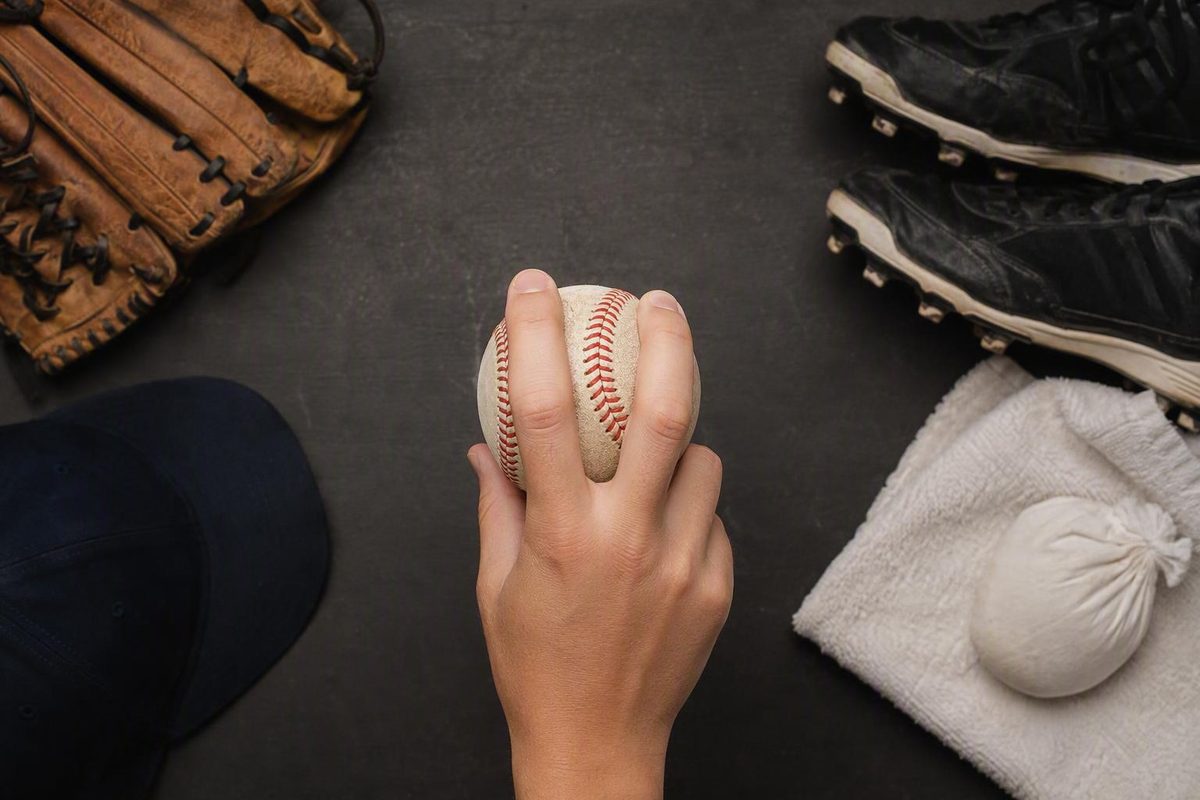
Every young pitcher wants to learn the curveball, and every trustworthy pitching curriculum starts somewhere far less glamorous: the four-seam fastball, thrown to a spot, over and over. That ordering is not conservatism — it is how pitching development actually compounds.
The grip
Lay the index and middle fingers across the horseshoe seam — perpendicular to it, fingertips resting on the far seam, a finger-width apart. Thumb underneath, on or near the bottom seam, roughly bisecting the fingers above. The ball sits out toward the fingertips with visible daylight between palm and ball: a choked, deep grip costs velocity and feel. Fingerpads on seams is the whole point — four rows of stitching bite the air per rotation, which is where the name comes from.
Why it flies straight
Released with pure backspin, the four-seam’s rotation creates lift (the Magnus effect) that offsets gravity’s drop — the pitch doesn’t literally rise, but it falls less than the eye expects, which is why well-located four-seams get swings underneath. More important for a developing pitcher: it is the straightest pitch available, and straight is a feature. A pitch that goes where the arm sends it teaches command; a pitch that moves teaches excuses.
Why it comes first
Three compounding reasons. Command transfers. The release point and arm speed grooved by ten thousand four-seams are the platform every other pitch launches from — a changeup is a four-seam arm action with a different grip; a slider is a four-seam release with late adjustments. Build the platform crooked and everything on it leans. Velocity develops safely. The four-seam is thrown with full, natural arm action — no wrist manipulation — making it the pitch that builds arm strength with the least added stress. The pro pattern agrees. At every level including MLB, the four-seam remains the most-thrown pitch; the pitchers who dominate with breaking balls do so off an established fastball, not instead of one.
The practice that makes it count
Grip it identically every time — eyes closed, out of the glove, until the fingers find the seams without looking. Then throw to targets, not just to a catcher: quadrants of the zone, called before the throw, tracked out of ten. A young pitcher who can put a four-seam in three of four quadrants on demand is ahead of one who can spin a curve — and, unlike him, is building an arm that will still be attached to a career at eighteen. The curveball can wait; it will arrive to find the throne already built.